Clear Coat Removal or Clear Coat Preservation-Which is Best?
removing scratches is impossible without removing clear coat! This is going to be an in-depth look at clear coat removal, so hang on tight!
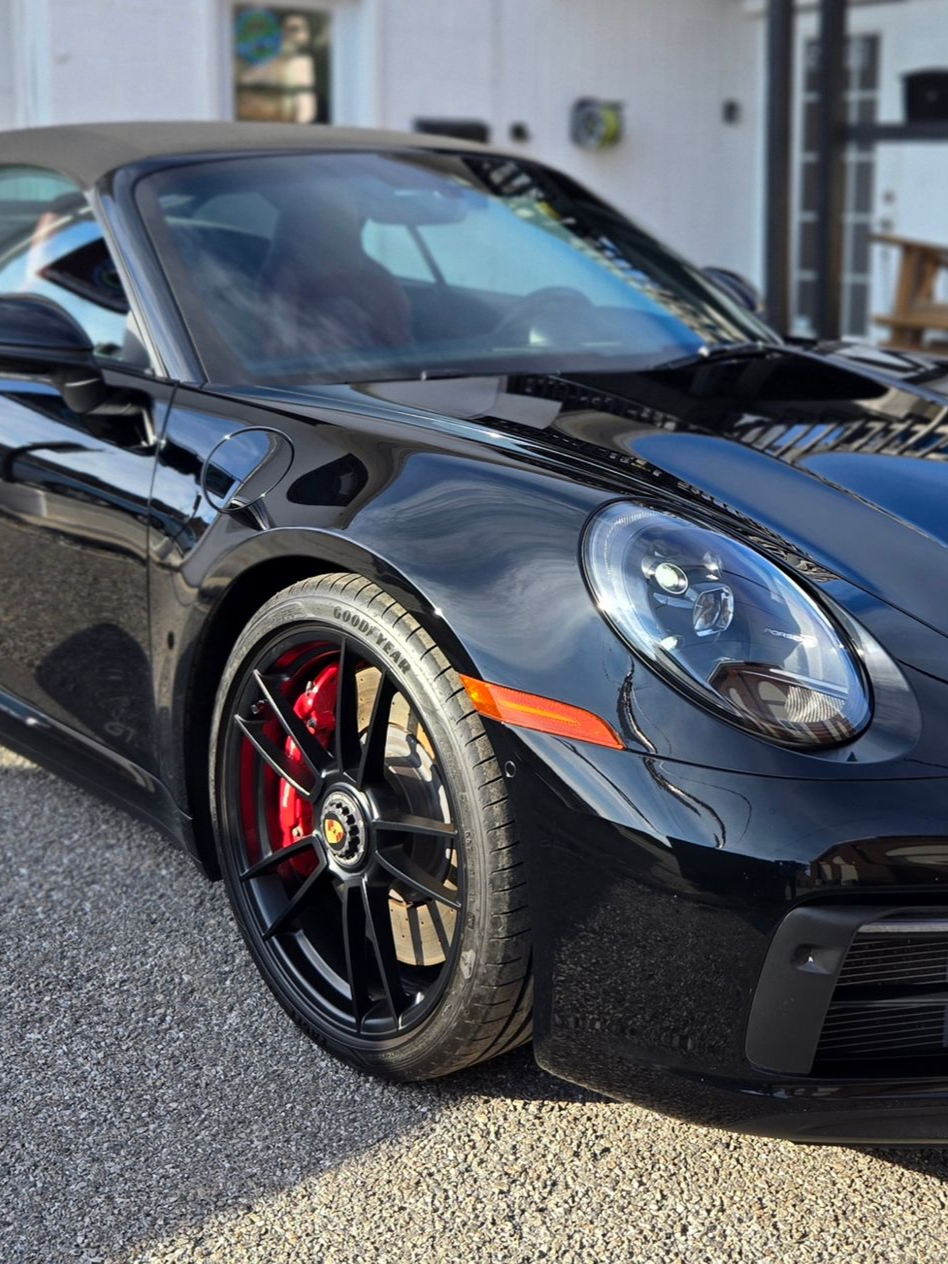
Those of you who have never thought about this topic ever, that is perfectly ok. This discussion occurs in the detailing world quite a bit. As a vehicle owner you only know that your car needs to be detailed. You leave the rest to us, which is the way it should be. Let us have this discussion, you just find a detailer you trust.
Most of the discussion in the detailing world is pretty one-sided. "Scratch removal" is important to a detailer. The fact that the finish needs to be as scratch-free as possible. What is scratch removal, really? What does clear coat do? Should any or all scratches be removed? Every detailer has their own perspective on this topic, but I am not going to look at this from a detailer's perspective in this blog. We are going to look at clear coat and scratch removal from a fact-based and customer perspective as much as I possibly can.
A little background on me as a detailer and my perspective on this topic. I own and operate Wax On Wax Off Pro Detailing and Ceramic Coatings in Hanover, PA. I grew up in the dealership. I was detailing in the late 90's and I've seen a lot of clear coat in my day. I've seen old, really old, and really, really old clear coat, as well as modern clear coat, which is around 2007 and up. In the 90's paint was much thicker, harder, and every vehicle was scratched to pieces. A regular soap wash was all that was needed to clean the paint. The rest of the time was spent buffing the bageebers out of the clear coat. It was some hard clear coat. Today, the opposite is true. Paint is thin and soft. Multi chemical washed are necessary and just a little bit of polishing makes the clear coat glow like the sun.
Today, vehicles are lasting longer and longer. No one was thinking about clear coat preservation 30 years ago because we only expected the vehicle to last about 100,000 miles. That fact was fairly accurate. Today, we are seeing 200,000 plus miles and more than 12 years of life. Clear coat is expected to withstand the elements for about 10 years. By then, all of the UV blockers are gone.
We also weren't thinking about clear coat depth or removing the UV barrier either. Total paint system thickness is about 130 to 150 microns on average. That is primer, paint, and clear coat. Clear coat makes up for about 40% of the total thickness. It's about 35 to 50 microns on average. An example of paint system thickness is about the thickness of a post-it note. That's about 70 microns or a little more. Of course, that is much thinner than most paint systems. Clear coat thickness is about the same as the cellophane wrapping of a cigarette pack. Peal off that wrapping and press both sides together and you have about 35 to 50 microns.
There are two schools of thought on clear coat removal. One is that scratches are the worst enemy of the clear coat. They all must be removed or as much as possible should be removed and the other is that environmental fallout, chemicals, tar, dirt UV, and oxidation are the enemies. That scratches are just part of life, like wrinkles. The former school of thought says that a "paint correction" MUST be done. The latter thought says that the paint (clear coat) MUST be preserved-as much left intact as possible. Let's explore both of these thoughts.
When a client asks me about needing a "paint correction", I ask them every time what exactly they mean. Their answer is the same every time. They say they don't know what it means. I will define it for you and then explain why I put it in quotes. The term "paint correction" started around the early 2000's as the internet was just being formed in those early days. Most likely, this term came about in the detailing forums. No one has been given the credit for first using it because once the term came to be it was everywhere and anywhere. This term is said to separate the two different approaches to making paint look better. There is the method of making it glossy and then there is the method of making it glossy and removing scratches. So, it's a longer, more time consuming process and another way to meet the wishes of some clients while charging them more.
The reason I put that term in quotes is because the more time spent polishing the more clear coat is being removed. Scratches aren't being removed as much is clear coat is being removed. The thickness of the clear coat has been depleted, therefore, the scratches aren't visible anymore. The same principle applies in sanding wood to smooth it out. The wood thickness is being brought lower to make the knot appear less noticeable. Now, in the case of wood, it's two inches thick, so it's ok to lose a 1/16th of an inch. It makes no difference. With clear coat, losing 5 microns is a lot.
Now, from the research I have done, some reports made for body shops have been put out that suggest that it's ok if 25% of the clear coat is removed over the life of the vehicle. That's about 8 to 12.5 microns. From what I understand, The UV blockers are contained in that top 25% or 8-12.5 microns. So, if "paint correction" is done four times in 10 years, then that means about 2-3 microns is being removed each time. If it gets done one time over that 10 years and 5 to 10 are removed at one shot, then it can't be done again and almost all UV blockers have been removed. Most likely, when a "paint correction" is done it is removing at least 5 microns of clear coat. Wet sanding removes even more than that.
My contention is not that scratches should never be removed. If that's what you want then we can have that conversation. I will charge for it, of course. However, you most likely can't see most of them, which is a good thing. Scratches do hide in plain sight. I'm not talking about the scratches you can park a bus in. I'm talking about the ones that live in the upper 10 microns. The wash, or neglect scratches. These scratches, bye the way, didn't get there by accident. They came from improper, aggressive washing, the automatic car wash, or from not having your vehicle detailed. Yes, the dirtier and more miles driven a car is the more scratches will accumulate. Ultimately, I don't want you to be able to see the scratches. If you see none, then that's great. Besides, the lights I use to look at the paint are insanely intense. Even the sun doesn't reveal everything my lights reveal.
Clear coat has a lifespan. The clock starts ticking on it as soon as it's cured at the factory. Quickly, it begins to oxidize and deplete just from existing in the environment. Doing nothing to it and nature will begin to remove it without interference from a polisher. If we remove clear coat by polishing we are actually speeding up the delamination process. Now, on a bit of a sidenote, a ceramic coating is the only thing that will "save" the clear coat. However, can we still remove 5 to 10 microns if the coating is only 3 microns thick? A coating can never "replace" the loss of the clear coat. It can only preserve it from that point on. The issue is, what durability level of coating are you having put on? A lower premium coating? A mid-tier coating? So, you will need another coating in 5 years? But 5 microns has already been removed. Do you think more scratches will accumulate over 5 years? Yes! Coatings help reduce wash scratches, but they will still accumulate. Did you also know that the most dense and hardest part of the clear coat is contained in that top 25% or 8 to 12.5 microns. Your clear coat is a lot softer now than when the scratches were there! Will scratches accumulate more easily now? Yes, absolutely they will!
Who is telling you that your clear coat is scratched up? The detailer, probably. I ask my clients every time their vehicle comes in for a ceramic coating if there is anything on the exterior that they notice, needs to be removed, or what, if any issues the exterior has. Almost always, they point out a deep scratch or two that we can't do anything about. They almost never notice anything else other than it's dirty and needs to be restored to clean and shiny. YouTube sells the fact that clear coat must be scratch-free. I am so thankful that most of my clients stay off of YouTube for the most part. As long as they only watch my videos then we are good. I have had people tell me that they watched a video from some detailer in California and he said X, Y, Z. What does what he says have to do with your vehicle? I am the one looking at it. I am your best hope of giving you what your vehicle needs.